

Anmod om et tilbud
Indsend feedback
Nyheder

Old Power Strip: Safety Risks, Lifespan & When to Replace It
 2026.06.15
 Industri -nyheder
Most households have at least one power strip that has been plugged in for years without a second thought. It still works — devices charge, lights turn on, appliances run — so the assumption is that it must be fine. That assumption is where the risk begins. A power strip that functions is not the same as a power strip that is safe, and the gap between those two states widens quietly with every passing year.
Why an Old Power Strip Becomes a Fire Hazard
Power strips age from the inside out. The visible plastic housing may look unchanged for a decade, while the internal components that determine electrical safety degrade continuously from the moment the unit is first used.
Several failure mechanisms operate simultaneously in an aging power strip:
- Insulation brittleness: The polymer insulation surrounding internal wiring becomes brittle over time, particularly in units subjected to repeated heating and cooling cycles. Cracked insulation creates conditions for short circuits — the most common direct cause of power strip fires.
- Contact oxidation: The metal contacts inside each outlet develop an oxide layer with age and use. This increases electrical resistance at the contact point, generating localized heat each time current flows. In heavily loaded outlets, this heat buildup can ignite surrounding materials.
- MOV degradation: Power strips with surge protection contain metal oxide varistors (MOVs) — components that absorb excess voltage from electrical spikes and divert it safely to ground. Each surge event consumes a portion of the MOV's capacity. Once depleted, the unit provides no surge protection, but continues drawing current — and a subsequent surge can cause the exhausted MOV to overheat and catch fire.
- Mechanical loosening: Outlet contacts loosen with repeated plug insertion and removal. A loose connection arcs — producing small electrical sparks each time current flows across the gap. Arc faults are a leading cause of residential electrical fires.
The U.S. Consumer Product Safety Commission has documented the scale of this risk directly: investigations found that faulty extension cords and power strips with undersized wires, loose connections, and improper grounding pose serious fire, shock, and electrocution hazards, leading to dozens of recalls affecting millions of units. Age accelerates every one of these failure modes.
How Long Do Power Strips Actually Last?
There is no single expiration date stamped on a power strip, which is part of why so many units stay in use long past their safe operating window. Most electrical safety experts place the practical lifespan of a quality power strip at two to five years under normal household conditions. Units used in environments with frequent power fluctuations, high ambient temperatures, or heavy continuous loads will reach the end of their safe life faster.
Several factors determine where a specific unit falls within that range:
- Surge frequency: Every power surge partially depletes the MOV in a surge-protected strip. Households in areas with unreliable grid infrastructure, frequent thunderstorms, or older building wiring will cycle through protection capacity faster than those on stable power.
- Continuous load: A power strip running high-draw devices — space heaters, desktop computers, monitors, gaming systems — at or near its rated capacity generates more internal heat per hour than a lightly loaded strip. Sustained heat is the primary driver of insulation degradation.
- Housing material: Power strips made with polycarbonate (PC) housings offer better heat resistance and flame retardancy than lower-grade plastics, extending the window before the housing itself becomes a hazard. Material quality directly influences how gracefully a strip ages.
- Number of insertion cycles: Outlet contacts are rated for a finite number of plug insertions. Strips used in high-traffic locations — workbenches, desk setups with frequently swapped devices — wear their contacts faster than bedside units with the same devices plugged in year-round.
A power strip that is more than three years old and cannot be traced to a purchase date should be treated as past its reliable service life, regardless of whether it appears functional.
Warning Signs Your Power Strip Needs Replacing
Because internal degradation is not visible, the warning signs of a failing power strip show up as behavioral changes rather than obvious physical damage. The table below maps the most common indicators to their likely causes and appropriate responses.
| Warning Sign | Likely Cause | Action |
|---|---|---|
| Burning or plastic smell during use | Overheating contacts or degraded insulation | Unplug immediately; do not reuse |
| Strip or outlet feels warm to the touch | Elevated contact resistance or overloading | Reduce load; replace if warmth persists |
| Discoloration or scorch marks on housing | Past overheating event; arc fault | Replace immediately |
| Plugs fit loosely in outlets | Worn outlet contacts | Replace; loose contacts arc under load |
| Surge protection indicator light off | MOV capacity depleted | Replace; unit no longer protects devices |
| Intermittent power to connected devices | Loose internal wiring or failing contacts | Replace immediately |
| Cracked, frayed, or stiff power cord | Insulation brittleness from age or heat | Replace; damaged cord is a shock hazard |
| Circuit breaker trips repeatedly | Internal short circuit or sustained overload | Diagnose load; replace strip |
The absence of visible warning signs does not mean the strip is safe. MOV depletion and insulation degradation are invisible. A strip can fail the next surge event with no prior visible indication.
The Hidden Danger: Overloading Old Power Strips
The power demand of a typical home setup has increased substantially over the past decade. USB-C fast chargers, gaming consoles, multi-monitor desk setups, and streaming devices draw significantly more continuous current than the televisions, lamps, and VCRs that defined household electrical loads when many older power strips were manufactured.
A strip rated for 1,500 watts at 10 amps handles modest loads comfortably when new. The same strip, aged five or more years with degraded contacts, may overheat at 70% of that rated capacity because the resistance at each connection point has increased. The nameplate rating reflects performance when new — not performance after years of use.
Never plug high-draw appliances into a power strip at all, regardless of its age. Space heaters, air conditioners, refrigerators, microwave ovens, and washing machines should connect directly to wall outlets. These devices draw sustained high current that exceeds what power strip wiring is designed to handle continuously, and doing so is one of the most common causes of power strip fires even in relatively new units.
What to Look for When Replacing a Power Strip
Replacing an old power strip is an opportunity to upgrade to a unit with better safety features rather than simply repeating the same purchase. The following specifications make a meaningful difference to both longevity and protection:
- Overload protection circuit breaker: A built-in circuit breaker trips automatically when total current draw exceeds the strip's safe capacity, cutting power before the wiring overheats. This is the single most important safety feature and should be considered non-negotiable. A PC material power strip with overload protection switch combines flame-retardant housing with this automatic cutoff — two layers of protection in one unit.
- Housing material: Polycarbonate (PC) is inherently more flame-retardant and heat-resistant than standard polypropylene. For environments where the strip will run under sustained load, the housing material matters. A PP material power strip with built-in overload protection offers a lighter-weight alternative where flame retardancy is addressed through the protection circuit rather than the housing alone.
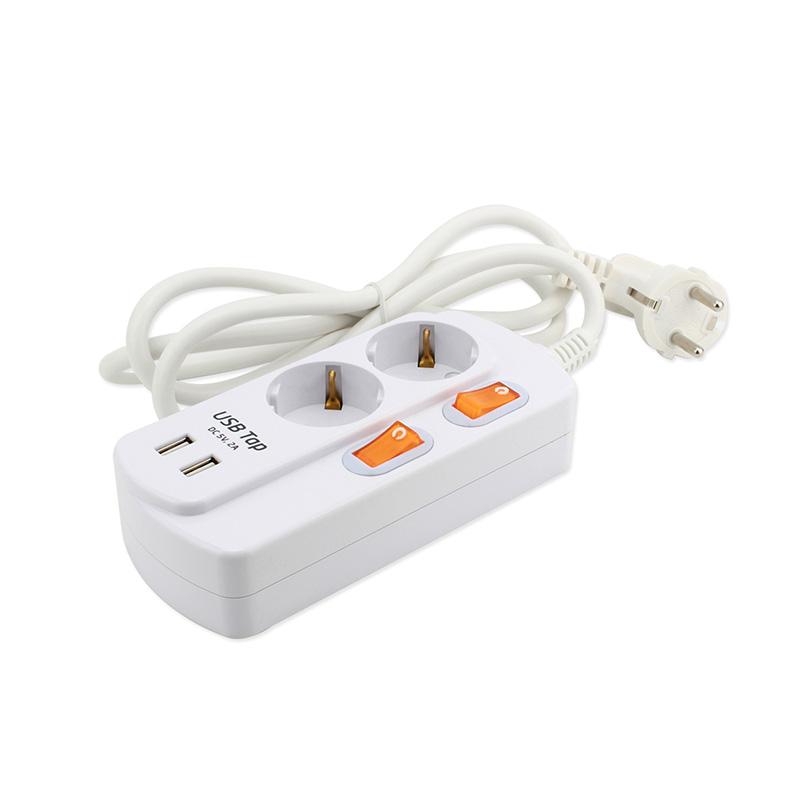
- USB charging ports: Integrating USB ports directly into the power strip reduces the number of bulky wall adapters occupying AC outlets — adapters that partially block adjacent sockets and contribute to overloading. A power strip with USB ports for modern multi-device setups handles phone, tablet, and accessory charging through dedicated charging circuits rather than drawing from the AC outlets.
- Outlet count matched to actual need: Buying a strip with more outlets than needed encourages plugging in additional devices over time, gradually creeping toward capacity. Choose a strip sized for your realistic load, not for hypothetical expansion.
- Safety certification: Look for UL, CE, or equivalent national certification marks. These indicate the unit has been independently tested against minimum safety standards for wiring gauge, insulation quality, and contact durability.
Safe Usage Habits to Extend Power Strip Life
Even a high-quality new power strip degrades faster under poor usage conditions. A few consistent habits significantly extend the reliable service window of any unit:
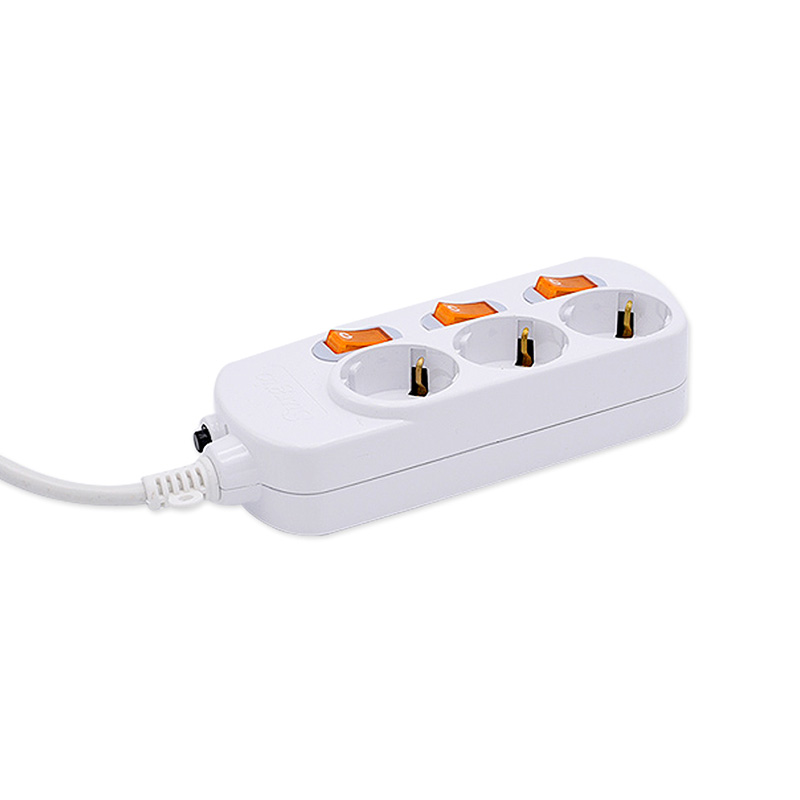
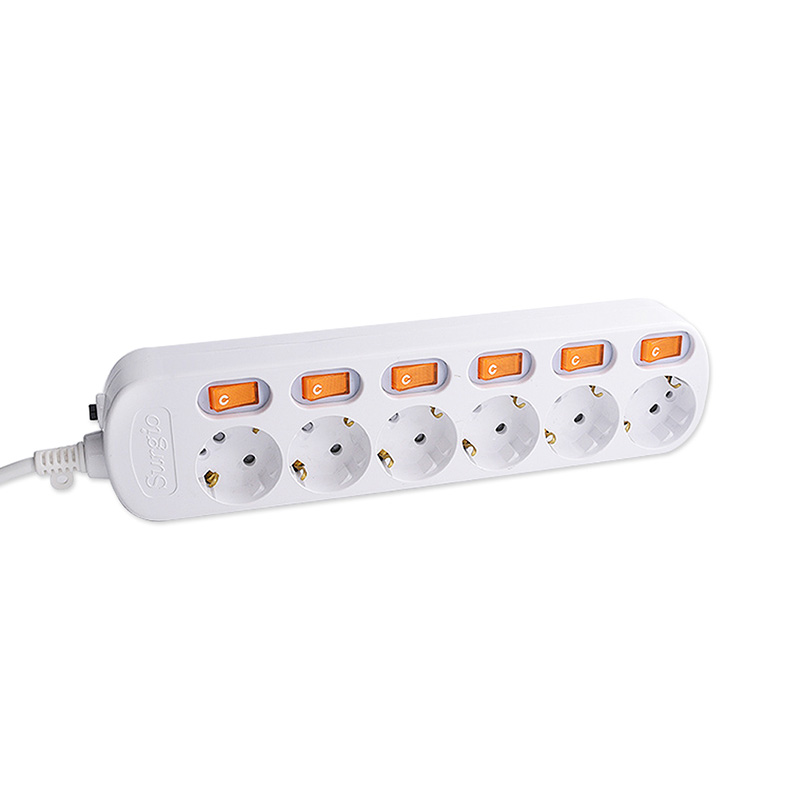
- Use per-outlet control where possible. A power strip with independent switches for per-outlet control lets you cut power to individual devices without unplugging them. Switching off outlets that are not in active use reduces cumulative heat exposure to the strip's internal wiring — one of the main contributors to insulation aging.
- Never run cords under rugs or furniture. Covered cords cannot dissipate heat and are invisible when they begin to overheat. Cord damage under a rug often goes undetected until a fire starts.
- Keep the strip off the floor when possible. Floor-level placement increases exposure to dust accumulation inside outlet openings, which can cause arc faults, and makes it easy for liquids to reach the unit.
- Do not daisy-chain power strips. Plugging one power strip into another multiplies the risk of overloading and bypasses the protection rating of each individual unit. If you need more outlets in an area, have a licensed electrician add a dedicated circuit.
- Set a replacement schedule. Mark the purchase date on the strip with a label or note it digitally. A three-year review cycle prompts you to evaluate whether the unit should be replaced before problems develop — rather than after a failure event forces the decision.
An old power strip that still turns devices on is doing the minimum it was ever designed to do. Whether it is doing so safely — without degraded contacts arcing, without exhausted protection components, without brittle insulation waiting for a fault condition — is a question the unit itself cannot answer visibly. Treating power strips as long-term infrastructure rather than replaceable consumables is the single most common mistake that turns a minor convenience product into a household fire risk.
 Eng
Eng
Produkter
Kontaktinfo.
- +86-18758062352
- +86-0571-64701616
- [email protected]
- Nr. 7, Xinqu Road, Xin’anjiang Street, Jiand, Hangzhou, Zhejiang, Kina

Copyright © 2023 Hangzhou Newmany Electronics Co., Ltd. Alle rettigheder forbeholdes. Power Strip Producent i Kina| Login

 TOP
TOP